Table of Contents
Letter from the Chair
CFP for NEMLA’s Spring 2026 Meeting
NEMLA Fall 2025 Virtual Meeting Summary
NEMLA Fall 2025 Listening Party Playlist
Beware of Phishing Attacks
News from our Members
— Catching up with Judy Pinnolis and Beth Iseminger
NEMLA Officers
Publication Information
**************************************************
Letter from the Chair
On my weekly walk in my local Audubon sanctuary on Sunday I was greeted with the first snowflakes of the season – a reminder that time and seasons continue on, no matter what we do, or what the world throws our way. I know that a lot of us are struggling with numerous stressors in the current environment, particularly after the horrific events of this past week. One thing that I am so grateful for is our community and our continued connection with each other.
In particular I want to extend my gratitude to Vice Chair/Chair-Elect Emily Colucci and the entire program committee (Erin Conor, Carol Lubkowski, Sandi-Jo Malmon, Brianna Pérez, and Laura Stokes) for organizing a phenomenal fall meeting. Thanks as well to our presenters Andrea Cawelti and Oluwafemi Ositade (Dating the Undated: Dating Resources for 18th-19th Century Music, with a Twist!); Tom Moore (Out of Prague: Jewish Emancipation and the Rise of the Jewish Piano Virtuoso); Laura Stokes, Nancy Jakubowski, and Carol Lubkowski (Lightning Talks: Lending Beyond Books, Scores, & Recordings); and, of course, thanks to Peter Laurence for running our listening party to close out the day. For those of you who could not make it, descriptions of the presentations are already up on the website, and slides and videos should be available soon, possibly by the time this makes it to digital print! I am looking forward to seeing people in person for our spring meeting, details to be announced.
In other news, Andrea Cawelti has agreed to lead the Technical Services Committee for the next term. We are grateful to her for stepping up at a time when we need to be focusing on all of the changes to that aspect of our profession that are emerging and soon to come (AI, the new RDA, changes to vocabularies in MARC, new platforms…).
And finally, I would like to encourage any and all who might wish to serve on a committee or in a leadership position to consider this, particularly at a time when attendance at national meetings is becoming more difficult, due to funding and/or life circumstances. NEMLA provides a conduit for New England music librarians to stay up to date on national trends, knowledge, and policies—it works because we make it happen, with our time, energy, and care.
And with that, I want to wish you all a lovely, restful holiday season.
Anne Adams, NEMLA Chair
Manager of Metadata Creation for Music
Eda Kuhn Loeb Music Library
Harvard University
Cambridge, Massachusetts
anneadams at fas.harvard.edu
CFP for NEMLA’s Spring 2026 Meeting
The NEMLA Program Committee invites proposals for presentations at our Spring 2026 meeting, to be held on Friday, April 17, 2026, at Harvard University in Cambridge, Massachusetts. We welcome all topics of relevance to music librarianship. We especially encourage early-career professionals, students, and first-time presenters to share their work with our community.
Proposals should include a summary of approximately three hundred words describing your topic, the approximate length of the presentation, and any technological or other needs or concerns you foresee. We would be happy to consider proposals for presentations of any length, including twenty minutes, thirty minutes, and forty-five minutes, as well as panel discussions and lightning talks.
Please submit proposals to Emily M. Colucci (ecolucci@bates.edu). The deadline is EOD Friday, March 20.
Thank you for your consideration, and we look forward to hearing from you!
NEMLA Program Committee
Emily M. Colucci (NEMLA Vice-Chair/Program Committee Chair)
Laura K.T. Stokes
Sandi-Jo Malmon
Carol Lubkowski
Brianna Pérez
Erin Conor
Submitted by Emily M. Colucci, NEMLA’s Vice-Chair/Chair-Elect & Library, Assistant–Access Services, at the George and Helen Ladd Library, Bates College
Save the date for the NEMLA Spring Meeting — April 17, 2026 — at Harvard University
NEMLA Fall 2025 Virtual Meeting Summary
The Fall NEMLA Meeting, held on Zoom on November 14, 2025, attracted 71 registrants. Chapter chair Anne Adams opened the meeting by welcoming all attendees, especially ones from the broader community who could attend because the meeting was free and virtual. Both she and program chair Emily Colucci thanked the program committee (Laura K.T. Stokes, Sandi-Jo Malmon, Carol Lubkowski, Brianna Pérez, and Erin Conor) and Secretary-Treasurer Hannah Ferello for handling registration.
Andrea Cawelti and Oluwafemi “Femi” Ositade, both of Harvard University, opened the program sessions with “Dating the Undated: Dating Resources for 18-19th Century Music, with a Twist!” Cawelti is the Ward Music Cataloger at Houghton Library. Ositade is a second year student concentrating in computer science and economics, working in the library on a grant-funded position.
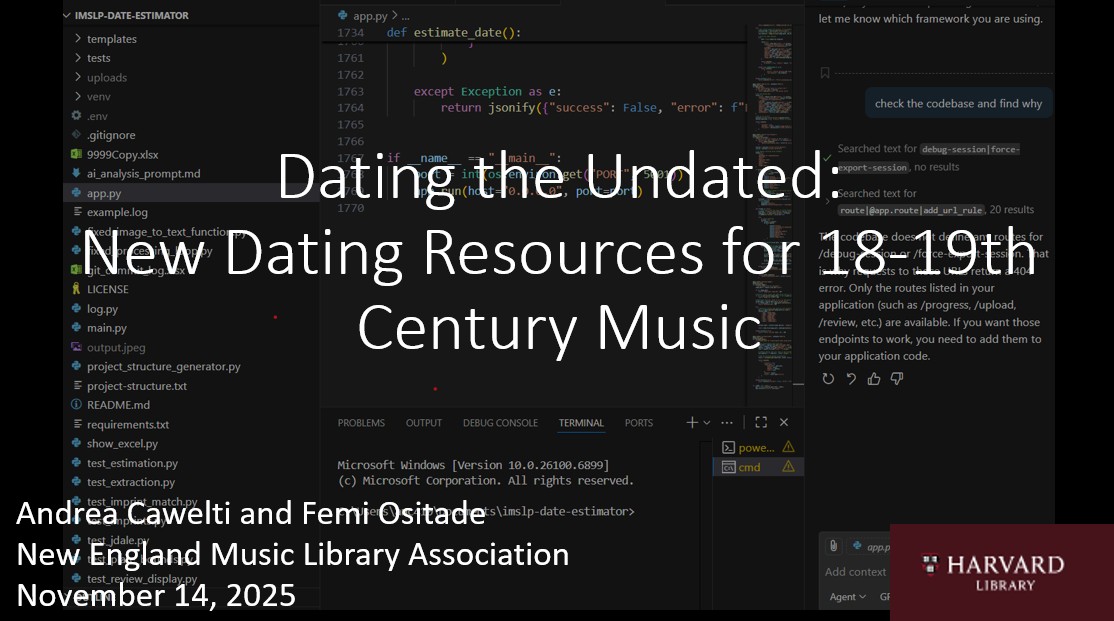
Cawelti outlined the problem: until copyright, music was often published without a publication date. Trying to determine this is time-consuming. Ositade observed Cawelti spending a large amount of time on this and proposed a way to automate this based on IMSLP data. They demonstrated the value of collaboration between people with expertise in different domains, music cataloging and computer science
Cawelti provided an overview of the traditional music dating resources, especially for publications from the 18th and 19th centuries. Indicators include publishers’ names and addresses, plate numbers, internal and newspaper advertisements, watermark dates, and publishers’ catalogs. She noted that Donald Krummel’s IAML book, Guide for Dating Early Published Music: A Manual of Bibliographical Practices (1974) is the premier guide to dating early published music, and there are several other reference sources. Now a lot of this information is available online including VIAF and the IMSLP Publishers’ Wiki. Library Hub Discover is particularly helpful.
She referenced her previous NEMLA presentation on using AI to do bulk creation of basic bibliographic information for scans of sheet music which could then be proofread and uploaded as the basis for MARC records. Harvard had been using an institutional grant to support the work, but it was affected by a hiring freeze. They secured an Advancing Open Access grant from the Arcadia Fund, which allowed the work to continue with Ositade because it was not subject to the hiring freeze.
Many are familiar with IMSLP’s huge collection of public domain scores, but it is backed by a lesser-known publishers wiki that Ositade used as the basis for an IMSLP date estimator. It works from an Excel spreadsheet of known bibliographic data, and it can output a specific year or a date range that is narrow enough for use. Cawelti can then review the output, decide if it is accurate and sufficient, then add the results to the spreadsheet used for batch creation of stem MARC records. During the Q&A, Cawelti stressed that human proofreading is still imperative and that the program works with all European languages.
Ositade then discussed the details of his work. He approached it by asking himself how he could make Cawelti’s job easier, especially by automating repetitive tasks to allow her to work on the tasks she’s more passionate about. He observed her checking pieces of data on the IMSLP publishers’ site and realized he could make the code do many of the steps, recognizing that the publicly-created wiki sometimes had gaps and inconsistencies. Broadly, he wanted to transfer logic into code and needed to work with Cawelti’s expertise to understand her processes.
As a next step, he’d like to incorporate other sources to narrow down date ranges further. They are looking for funding to do this.
Next (Stephen Thomas) Tom Moore, head of the Sound and Image Department, Green Library Library Florida International University, presented “Out of Prague: Jewish Emancipation and the Rise of the Jewish Piano Virtuoso.”
He opened by acknowledging his New England roots, including his birth in Newport, Rhode Island and studying music librarianship under the late Jean Morrow. He also acknowledged the difficulty of determining the religious identity of musicians, starting with the intentional omission of Jewish identity from Grove entries for most biographies.
In the 18th century, one quarter of the Prague population was Jewish, the second-largest population in any European city after Amsterdam, which had taken in many who’d been expelled from Portugal. Prague was a cosmopolitan city; German was widely spoken there in the 19th century, and operas were performed in Italian. Eventually, they built a theater specifically for Czech-language operas and another for German. Jews were still on the outskirts of society until the Edict of Toleration in the mid-19th century. Leipzig was an example of a place where Jews had previously been forbidden to live but could now reside as musical (and other) professionals. He discussed Philipp Broch and Bernhard Schreiber of Jewish successes in the arts.
He then provide overviews of half a dozen 19th century Jewish composers and virtuoso pianists in Prague:
- Sigmund Goldschmidt
- Leopold Lion, who received both position and negative press, the latter of which could be due to antisemitism
- Ignaz Wolfgang Amadeus Tedesco
- Charles Seymor Schiff, who demonstrated the advantages and disadvantages of being Jewish in that setting
- Charles Wehle
- Bernard Rie, a child prodigy on piano and a composer by age 19
The Q&A raised questions about whether any of them wrote synagogue music. Moore was unaware of any, and audience member Judy Pinnolis said it was unlikely. He also explained that there wasn’t a network between Prague and Paris due to the distance, but there was one in Central and Eastern Europe.
The afternoon resumed with a set of lightning talks on the theme “Lending Beyond Books, Scores & Recordings” by Laura K.T. Stokes and Nancy Jakubowski, both of Brown University and Carol Lubkowski, Wellesley College.
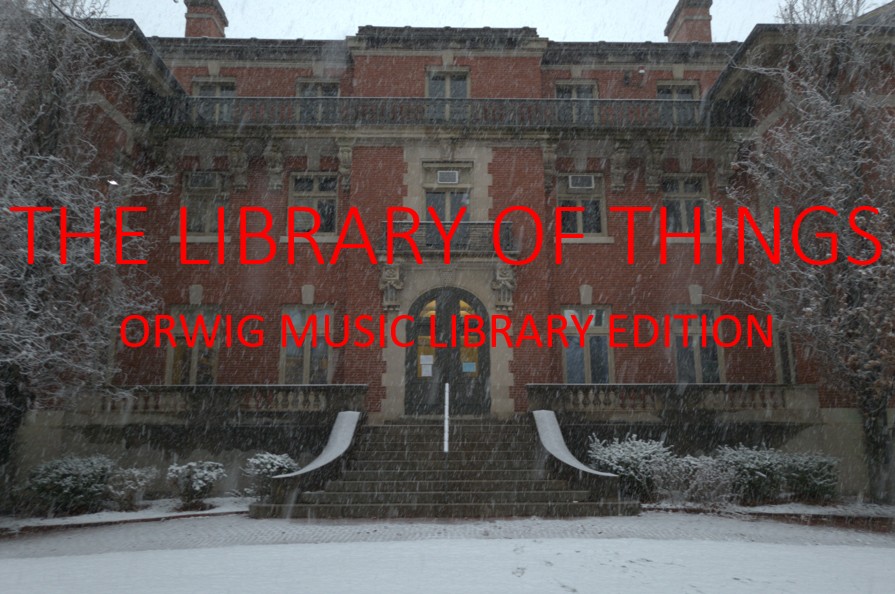
Stokes and Jakubowski discussed the library of things at Brown’s Orwig Music Library; Stokes also acknowledged Peter Riedel’s work on the project. They were already lending equipment when they added audio recorders and USB game controllers by request of a faculty member to support course reserves. Post-COVID, the university shifted to entirely digital reserves, but not everything needed for music coursework could be delivered digitally, starting with mbiras. These are treated as professor’s property, so the professor is responsible for tuning them between semesters.
They then added MIDI keyboards for another class, but they were available to all patrons, which spread via word of mouth. They didn’t include the manuals, but they did link to an online version in the catalog. They offered portable CD and DVD players, although vinyl is their most popular medium. They need to train and retrain student workers on checking items in and out, particularly for inventorying all parts. Jakubowski and Riedel have covered physical labeling of items and working with their reserves systems and ILS.
Stokes summarized by noting this service has strengthened relations with faculty, but they are dealing with issues of the equipment’s popularity beyond students enrolled in specific courses. Discussion arose in the Q&A about connecting legacy media players to modern equipment, and Lubkowski mentioned that her coworker found a way to zip-tie adapters to the equipment they lend.
Lubkowski discussed many things that the music library at Wellesley lends, noting that her branch is in the music department. They lend keys to the practice rooms, some of which have unusual instruments including a harp and an organ. They also lend A/V equipment including optical drives, microphones, and stands. They use a separate system, R&R rather than Folio, which allows patrons to reserve for specific times, but it is clunky to use. They also “lend” thesis carrels. These services are popular without being publicized.
Before opening breakout rooms for committee meetings, Adams encouraged all attendees to attend by reminding them of the various committees and their charges.
After the committee meetings, those who were still online reconvened to close out the day with a listening party hosted by Peter Laurence, Harvard University.
Meeting resources:
- Videorecordings of the meeting: Part I and Part 2
- “Dating the Undated” PPT
- “Out of Prague” PPT
- “The Library of Things”
Submitted by Marci Cohen. NEMLA Member-at-Large, Retired: Head, Music Library, Boston University
Thanks to Donna Maher, Reference and Instruction Librarian
University of Maine at Augusta Libraries, for uploaded the meeting resources to the NEMLA website.
NEMLA Fall 2025 Listening Party Playlist
Enjoy!
- Santigold – Ain’t Ready
- Bill Charlap
- King Sunny Ade – E Saiye Re
- 2 Cellos – Thunderstruck (cover)
- The Air Around Us (my own contemporary classical composition – sorry – inspired by non- “traditionally classical” performance practices)
- Cyndi Lauper – True Colors (Official HD Video) (in honor of her being inducted into the Rock and Roll Hall of Fame this year!)
- la Fitzgerald & Louis Armstrong – Cheek to Cheek
- Bill Evans
- La forȇt endormie – Tressé dans la terre
- Farewell to Stromness by Peter Maxwell Davies. Performed by the Los Angeles Guitar Quartet (LAGQ). Arranged by Scott Tennant
- Eric Nelson – “What does the Lord require”
- Arvo Pärt – Summa
Submitted by Peter Laurence, Librarian for Recorded Sound and Media,
Loeb Music Library, Harvard University
Beware of Phishing Attacks
Scammers continue to periodically send out emails requesting help with payment using NEMLA officer names. Note that we will never ask you to pay a bill temporarily for us. If you question the legitimacy of a message, please email the officer directly.
News from our Members
Catching up with Judy Pinnolis and Beth Iseminger
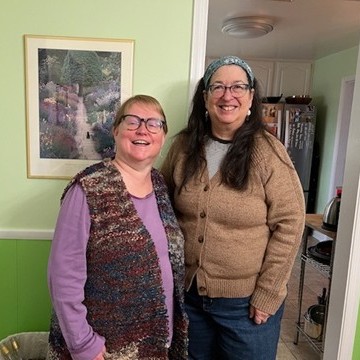
Judy Pinnolis sent this photo and some news from a visit with Beth Iseminger, an old NEMLA friend, in Maryland.
Beth was in NEMLA for about 10 years. Since 2017, she has been working for UMD on the International Piano Archives at Maryland (IPAM). It’s a collection of recordings and scores of primarily classical piano music by historic and current artists. Judy writes that it is hard to believe it’s been that long since Beth and Damian were in New England!
Judy and Beth are both longtime garden enthusiasts and did a seed exchange of seeds harvested this fall. Beth has a huge collection of seeds (and music) in her home.
Judy reports that she’s spent a good deal of time in her first months of retirement working in the garden and being outside and away from the computer. She taught a film class “films of Challenge and Resilience” for LLAIC (a seniors learning group) in the Fall, and worked on the completion of her online exhibit “Voices of Change” for the Milken Archive, which has now been also made into a book. Visit the exhibit at Milkenarchive.org.
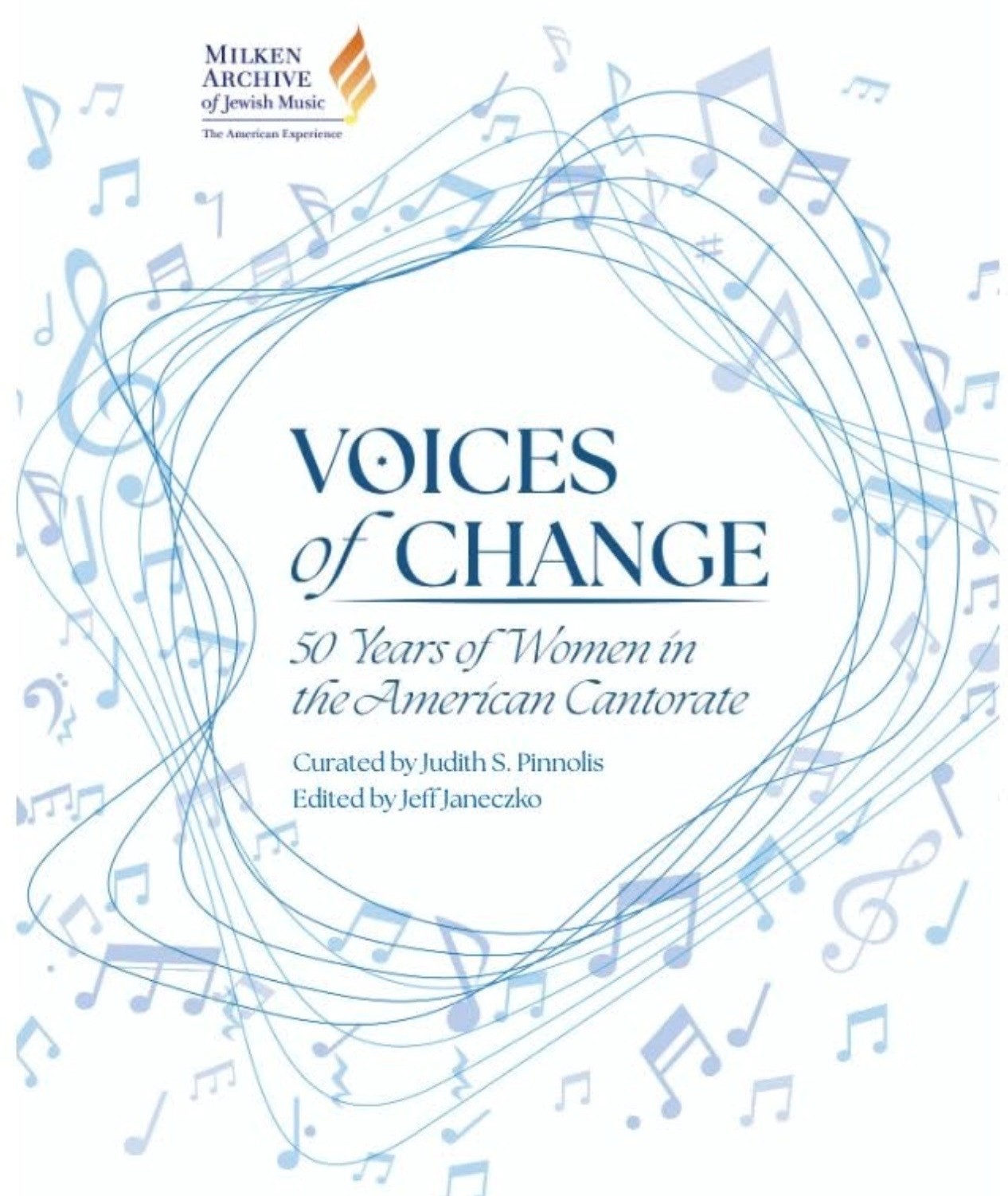
Submitted by Judy Pinnolis
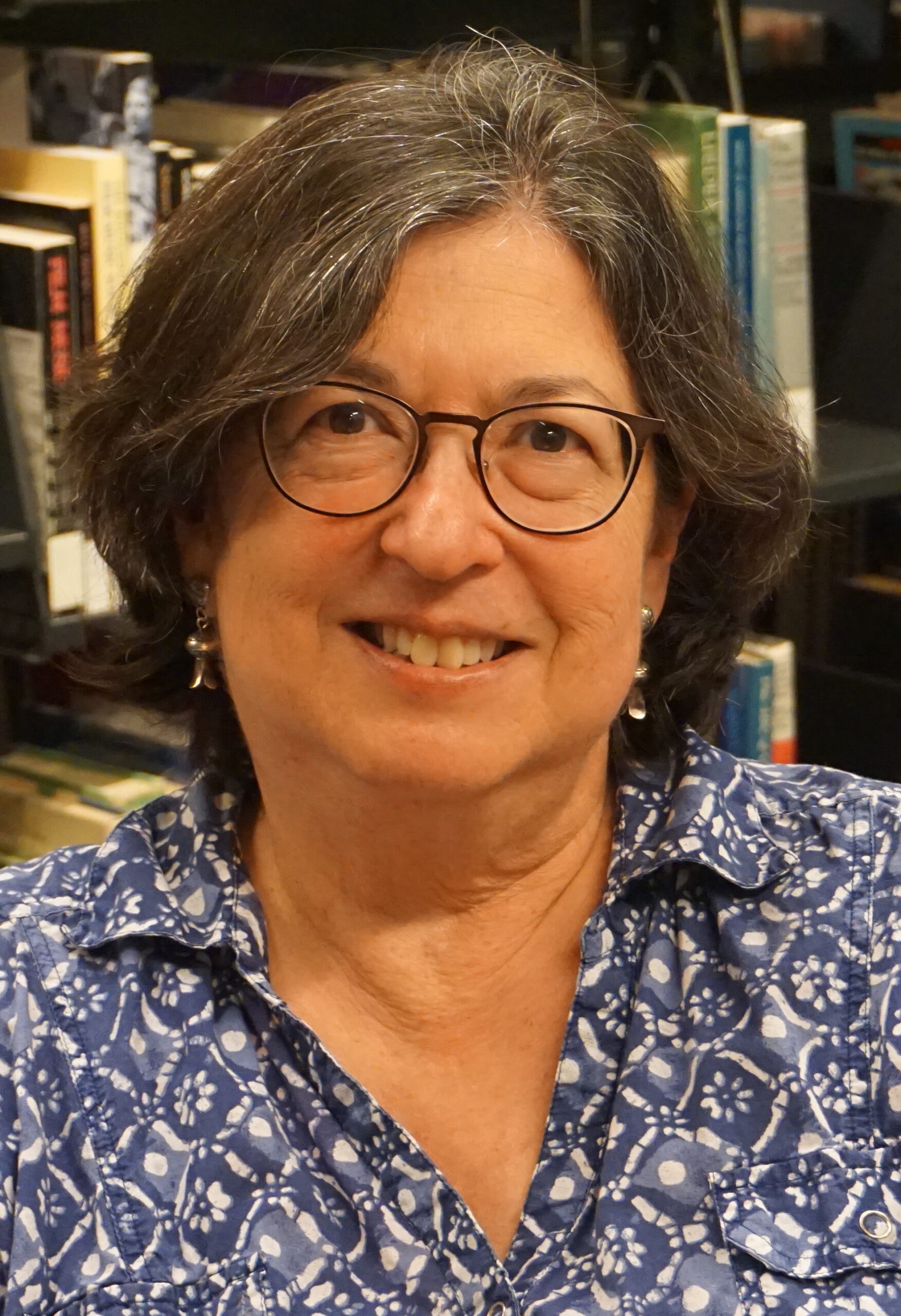
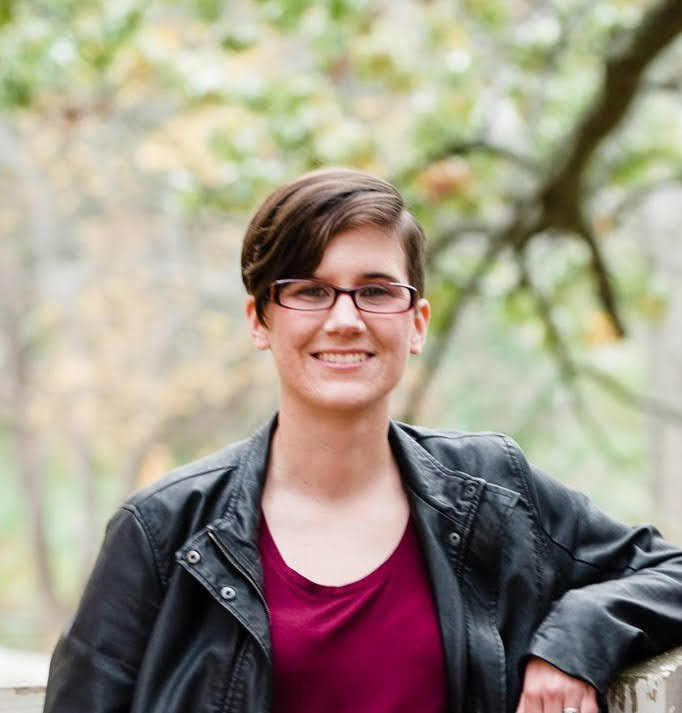
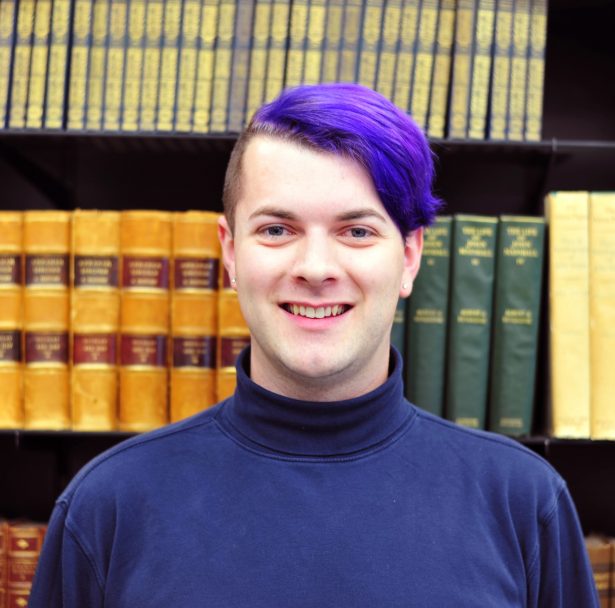
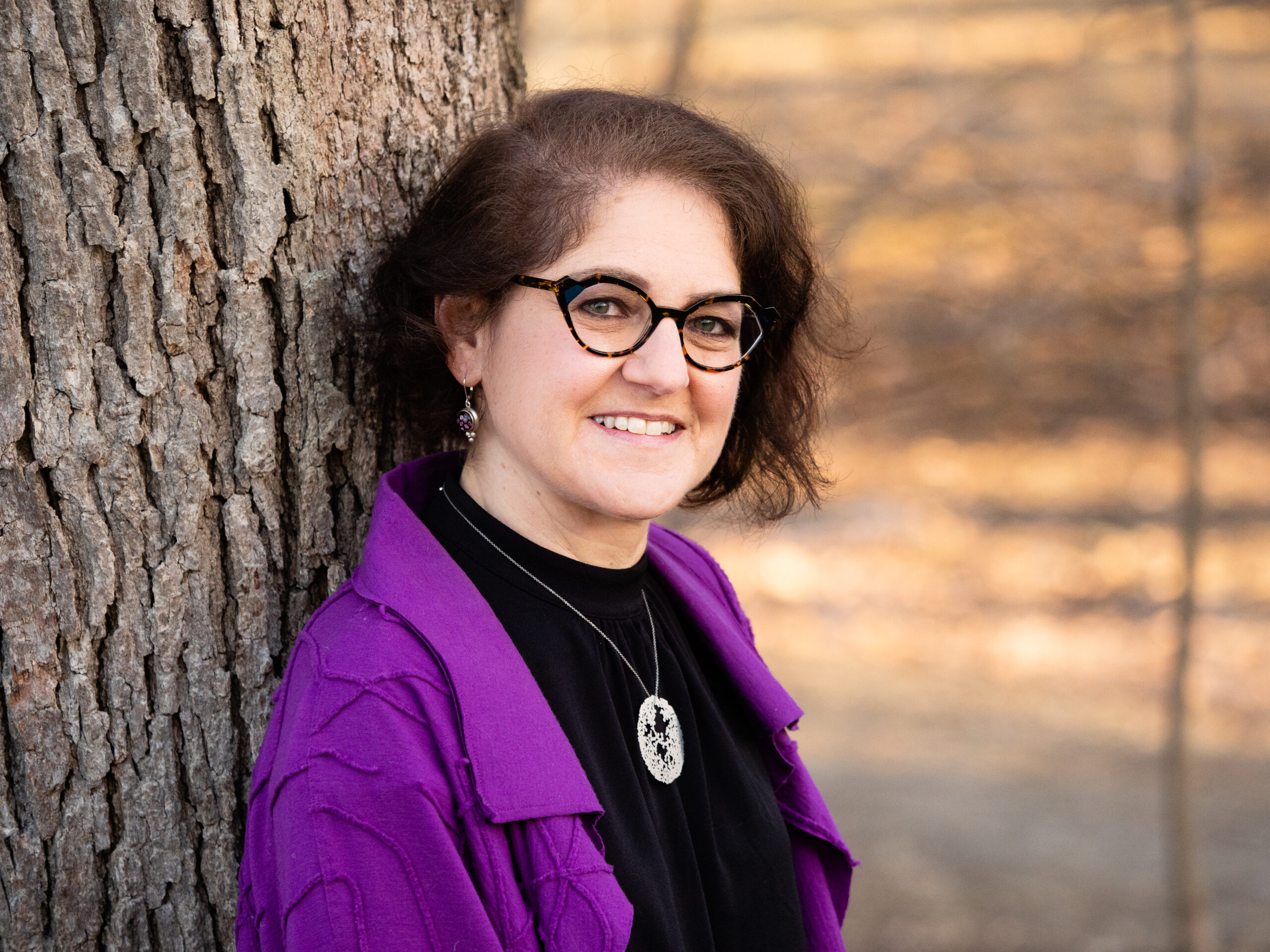
NEMLA Officers
Publication Information
New England Quarter Notes is published quarterly in the fall, winter, spring, and summer.
Back issues may be accessed from:
http://nemla.musiclibraryassoc.org/resources/newsletters/
Address all correspondence concerning editorial matters to:
Jennifer Hadley
jthom at wesleyan.edu
Inquiries concerning subscription, membership and change of address should be directed to:
Hannah Ferello
hannah.ferello at necmusic.edu
Membership year runs July 1st to June 30th.
Regular Personal Membership:$12.00
Student and Retired Membership:$6.00
Institutional Membership$16.00
Return to the New England Music Library Association home page